
 Lessons: 17Length: 1.5 hours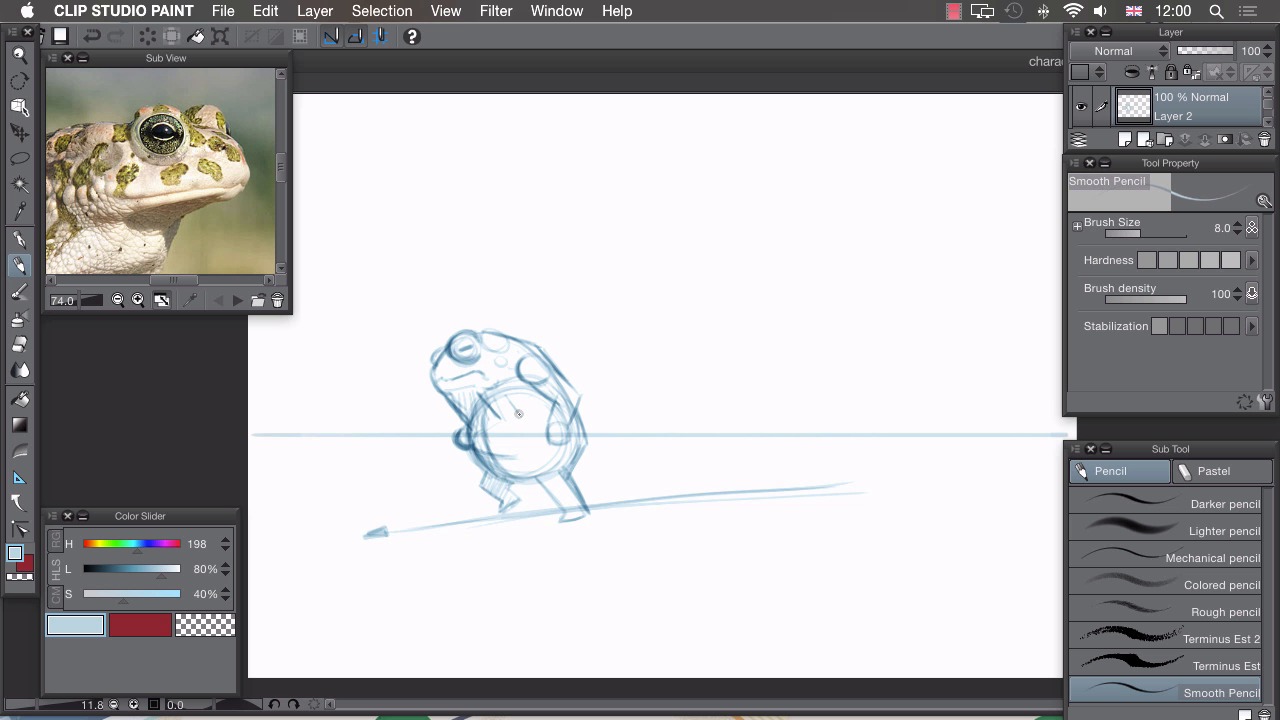
- Overview
- Transcript
2.2 Blocking In
In this lesson I’ll show you how to draw a very rough version of our idea, which will be the starting point for our proper drawing.
1.Introduction
1.1Introduction01:01
2.Sketching Our Idea
2.1Reference03:53
2.2Blocking In09:22
2.3Working Out the Perspective11:46
2.4Background09:57
2.5Character09:50
3.Inking
3.1Pen Setup05:44
3.2Inking Over Our Drawing09:18
4.Colour
4.1Flatting04:54
4.2Palette05:10
4.3Colouring03:17
4.4Shading04:41
4.5Line Colour03:28
5.Finishing Touches
5.1Colour Tweaks02:44
5.2Texture02:29
5.3Exporting02:24
6.Conclusion
6.1Conclusion00:41
2.2 Blocking In
Hi, welcome back. In this lesson, I'll be showing you how to build up a really rough sketch and get your idea down on paper. Now that we have our new canvas and we have all of our reference images into the sub view, it's time to start getting out the idea we have in our head and try to put it down onto paper. At this point, I won't be focusing on small details. I'll be focusing mainly on compositional aspects, so I'll be thinking about the placement on the page. I'll be thinking about the scale. I'll be thinking about the camera angle that I want to try and show. So at this point, the first thing I always do is get the ruler. So if I choose the ruler tool and choose a linear ruler, and I want to draw a horizon line in. So I'm thinking my horizon line should be about here. And then I choose the pencil tool. And I've chosen my favorite pencil, and I just draw along that ruler. I can then press O on my keyboard to select the ruler. And then press delete on the keyboard to get rid of it and then we have a drawn in horizon line. So, this is a really good starting point for any drawing because where you put your character on this horizon line, will dictate what kind of camera angle you'll be using. So, I know I want my character to have sort of a mid shot. So I want him placed sort of in the middle of our horizon line. So if I draw a big circle first Because I know I want this toad character to be quite fat and stocky. So he's gonna be pretty much all belly. So this circle represents his belly. And I'm gonna get sort of a mid point on this circle, to give it a little bit of a 3D feeling. So if you just draw a mid point on your circle. Like that. So that represents a sort of a division on this sphere. And then I can cross that to show how that would go horizontally. So now this represents the majority of the bulk of my character. I'm thinking of it as sort of a combination of a belly and the hips. And I'm gonna follow that line up and try and give him sort of a back, like that. So that's my thinking of hips leading up to a spine. And then his head will be around about here somewhere. And he'll be leaning forward, so I want to have this sort of shape, like this. I can then put in some legs. So, based on this center line that I've drawn on this sphere, I'm thinking that our character is sort of facing in this direction. So if I draw a line on the floor first, That's sort of the direction that our character will be walking, and, based on that, I can draw a couple of legs like that, so he's taking a step forward. Just quickly shade that in to show that it's the back leg, and this leg here is pushing on the ground, Giving him some forward momentum. So, based on these shapes, I'm quite pleased with what's going on so far. I can sort of build up a bit more of the toad attributes, but I'm not gonna focus too much on the details, just get the basic shapes in. So, if I put in his arm around about here, so that would his shoulder, and we've got his upper arm, his forearm, and his hand there. And because his hand has landed straight on this horizon line I know that his hand will be on the horizon line on the other side as well. So if you think the shoulders here would go down towards our horizon line so shoulder would be there. We have the upper arm, forearm, and then a hand hidden behind the body. I'll just suggest some eyes like this. So you've got the big bulbous toad eye. Like that. Wanna put in this big wart here. And maybe make his back a bit bigger and a bit more boxy to give him that sort of toad appearance. Like that. A suggestion of a mouth, a couple of warts, and you can always suggest a little bit of volume to remind yourself later on what you were meaning when you drew this rough sketch. So, with the placement of the hands there, we can then trace this forward and draw a push cart. So I have an idea of this character pulling a cart full of really big jars. So he's gonna need some handles. And seeing as his hand has land on our horizon line but always using this horizon line to try to build the illusion of 3D and depth. So His hands land almost horizon line. He's gonna be holding onto a handle like that, and this will be quite easy to draw, because this has landed on a horizon line and will always be horizontal, cuz it's really quite close on our horizon. So just really roughly sketch in this sort of idea of a handle. And like that, and we can have that on the other side. And from there, I think our handle will end here and will end on the corner of our cart. So if I draw a line straight up like that, that should indicate the corner of our cart. Next, I want to think the cart would be about this high, so if I just mark that off there. And using this horizon line, again, we know that our character is walking in this sort of direction. So we want our cart to get downwards towards the horizon line. But not too far. So we don't want anything like this which would be really quite an extreme perspective. We want just a very subtle perspective on that. Very, very slightly going downwards. I think that's about long enough. And then then do a vertical again and then we want the same for the bottom of the cart. So, if I just again very, very slight, but this time we're going upwards because our horizon line is in the middle. Like that. And then we can draw this side, as well. So that's the rough shape for our cart. We want some wheels on this cart as well. So I'm thinking this will be a two wheeler. So we'll need some support, for this side when he puts his cart down. So if we just put a leg on his handle like that and that one will probably be about there. Just a rough guess. And following. The line of his foot there, cuz he's gonna be pretty much in line with the wheel of our cart. So if we just draw a small indication of where the wheel will start, we can then draw an ellipse to represent our wheel. So I'm not being too precious. I'm just blocking in ideas and trying to get what I see in my head down on paper. The last element we have, he's going to be carrying some really big earthen ware jars. I'm not going to draw all of the jars. Instead, what I'm going to do is just draw a cube that represents the jars, so i want to show how tall the jars will be. And once we have our correct perspective figured out, in the next lesson, we can then start to draw the definite jaws inside of this cart. So, for the time being, if you just draw upwards from this corner again, because it'll be another cube contained by this smaller cube on the bottom. And this time, because we're a lot further away from our horizon line, our perspective will be a little bit harsher than it is on this line here. So, the further away a line is from our horizon line, the more the perspective will become apparent. So if I draw A line like that to represent our jar shapes, and then the vertical And then a vertical from here. And this top line. Again, going toward an imaginary vanishing point over here and our perspective is a little but harsher than it was nearer the horizon line. So this cube. I'm thinking that the jars will dwarf our character a little bit, so I've drawn the cube quite tall. And this cube represents the jars that we'll then fill in once we have our perspective all worked out. In the next lesson, I'll show you how to take your really rough sketch and figure out the correct perspective.


