
 Lessons: 12Length: 1.7 hours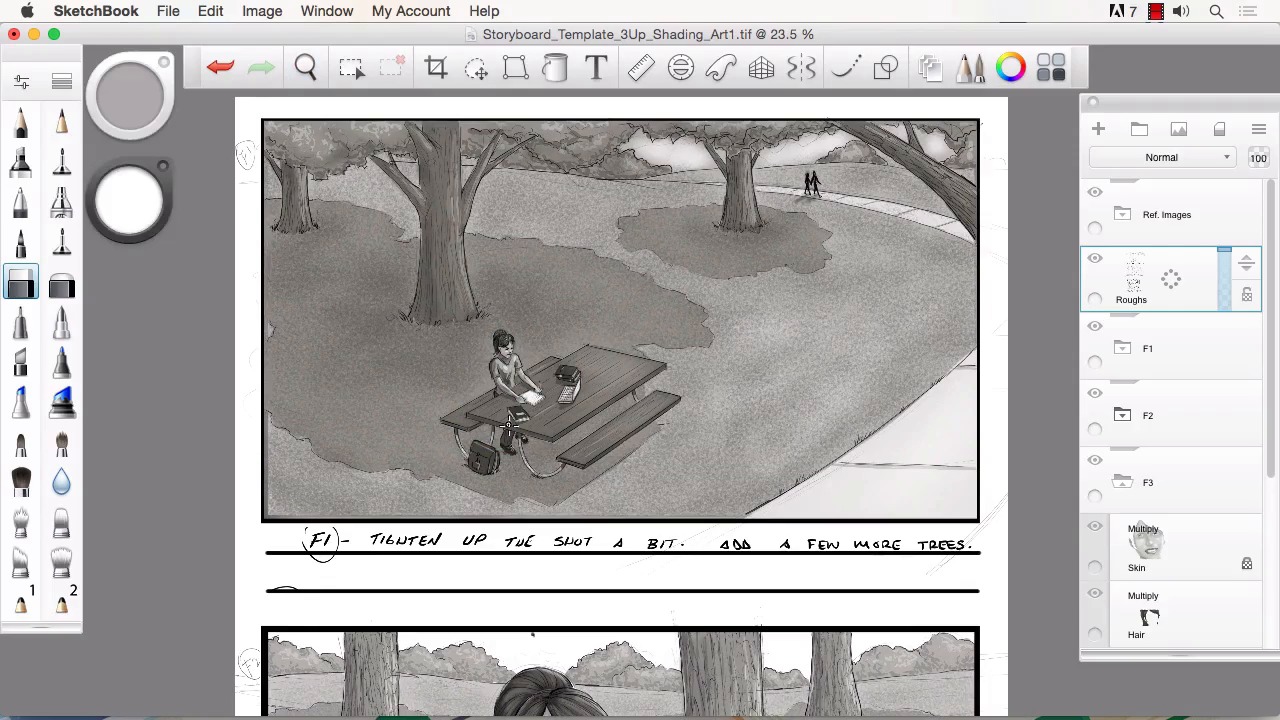
- Overview
- Transcript
4.3 Looking at the Finished Work Objectively
In this lesson we will go over the work and study it objectively. It is very important as an artist to do this so that your work will continue to improve. Because deadlines are often very steep in storyboarding, you must do this at the end of the project to gain new perspective for your future storyboards.
1.Introduction
1.1Introduction01:11
1.2Tools and Resources02:05
2.Creating a Frame Template in Sketchbook Pro
2.1Understanding Scale and File Size When Creating Storyboards05:27
2.2Creating a Template for Our Storyboard Frames07:34
3.Taking the Script to Rough Pencils
3.1Briefing Over the Script07:12
3.2Laying Out the Rough Pencils15:00
3.3Revisions to the Rough Pencils and Camera Angles11:25
4.Refining the Artwork
4.1Understanding When and How to Use References14:46
4.2Creating the Refined Artwork17:16
4.3Looking at the Finished Work Objectively04:53
4.4How to Save Files for the Client10:57
5.Conclusion
5.1Course Conclusion and Main Points02:42
4.3 Looking at the Finished Work Objectively
Welcome back to Storyboarding in Sketchbook Pro. I am Robert Marzullo. We're now gonna cover Chapter 4.3, looking at the finished work objectively. So now we've got our storyboard frames all shaded, ready to go, and ready to ship off to the client. But one of the things I like to do when completing any set of boards, is to look at the work objectively. And although I'm not gonna make many more changes at this stage, if any at all, I like to look at the work from a first perspective, and when I say objectively I mean to look at the work with no personal attachment. Don't let your emotions get in the way, and all the time and effort that you put into this, look at it as if you were a very new person to the project walking up and looking at it for the first time. Now, what that does for you is it allows you to see a little bit further into your work. And although, we are not gonna change it right now, we can use that information for the next job and the next job. And the reason why that it's so important with storyboarding is that the deadlines are often very steep, and sometimes you're not gonna be given the amount of time that you'd like to keep revisioning these boards. So it's important to look at the work and go, what exactly could I have done better? We'll take frame one for example, could I have used more variations and value in these tones? To really make this scene appear more realistic or more vivacious or more impactful. Is there issues with the perspective? Could the girl be smaller in comparison to the table, is the table in the correct perspective to the hills? All this information is what you wanna look at your work, and try to take something away from it, and be in remembrance for your next series of frames. Now, obviously your frames are probably gonna be entirely different each time you draw them, but there are certain scenarios you'll run into that'll be the same. Person is sitting at a table, person walking in the distance, trees. You're gonna draw trees, and parks, and stuff like that over and over again for various spots. So it's good to look at it, and say what can I do to make this scene better, and use that for the next time you draw it. Now, if it was a scene like this. If I was to look at this and say, what can I do to make this a better shot. I would say that she still looks a little bit unnatural as far as the way she is holding the pen, the shoulders and the shirt sill look a bit off maybe proportion or scale. Maybe even the head slightly larger. And I can say all these things about my own artwork, and not get attached, and not defend it. Which is very important, again, in storyboarding and just being a freelance artist in general. Without the ability to constructively take criticism and utilize it against your own work, you're gonna stagnate as an artist. So it's important that you can look at things like tha,t and take the constructive criticism, utilize it and move forward. So I'm not entirely saying that I don't like this scene. I just see areas where it could be better. And the close up here. One of the things to double check the work here would be to compare it to the scene previous and make sure that her face looks enough like the previous shot, the continuity. So the face itself I don't think is bad. The eyes look a little bit, maybe this one's down a little bit further. The smile could be a little bit more happy and a little bit more emotion there. And a lot of times that's something that you really have to work on with storyboards, because a big part of what you're doing as a storyboard artist is conveying emotion. So, and you don't think much about it as far as there being so many different degrees of emotion, but there really are. So depending on how bright the smile needs to be in conjunction with the script, that could be very important. So I think the smile should be toned up a little bit more there, and she should look even a bit more happy in emotion. So that's basically how I would look at these panels, and these frames, objectively and then try to, again, think about what I can do to make those better for the next set of boards. All right, that'll conclude this chapter. Next, we'll head over to Chapter 4.4, How to Save Files for the Client.


