
 Lessons: 18Length: 55 minutes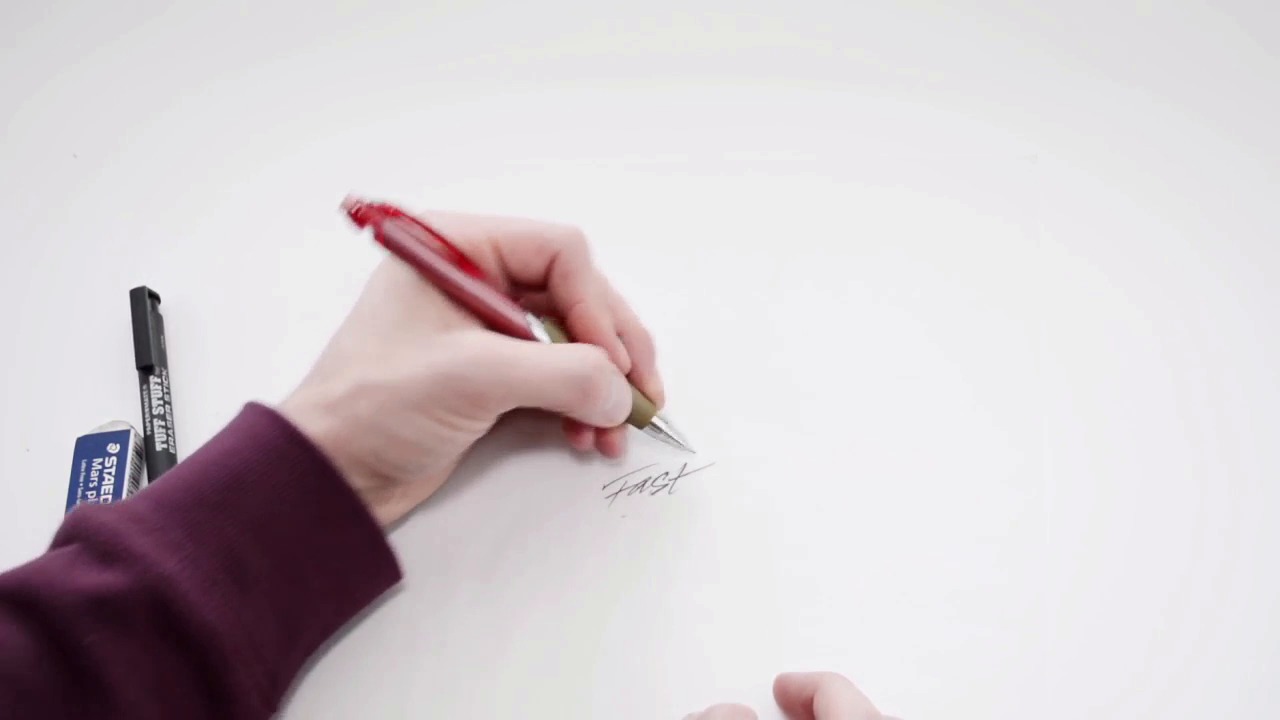
- Overview
- Transcript
3.1 Utilizing Handwriting
Within this chapter we will finally begin practicing informal script! This video will explain how you can edit and alter your very own handwriting to make a finalized piece of informal script lettering.
1.Introduction
1.1Introduction01:22
1.2Supplies01:01
1.3What Is Script Lettering?02:33
2.Formal Script Lettering
2.1Breaking Things Down02:10
2.2Understanding the Proper Angle08:02
2.3Smooth Connections02:52
2.4Thicks and Thins03:18
2.5Flourishing04:28
2.6Uppercase01:52
2.7Extremum Vectoring02:49
3.Informal Script Lettering
3.1Utilizing Handwriting05:03
3.2Varying Angles and Rhythm03:26
3.3Stabbing Connections01:45
3.4Alternate Letterforms04:27
3.5Process to Final02:09
3.6Vector Techniques04:42
3.7Further Research01:59
4.Conclusion
4.1Conclusion00:43
3.1 Utilizing Handwriting
So welcome to chapter three, we are going to finally tackle informal script lettering. Which is probably my favorite, because of the variety of styles you can achieve through the editing process. So, with informal script, it's very relateable to handwriting. And a lot of the pieces I have completed have been derivative of my handwriting, somebody else's handwriting, something I've come across in my internet travels or even keeping receipts from restaurants. I have a collection of receipts from restaurants when waiters might write thank you to you. And just truly understanding that each letter form is completely different in its own unique character. So referencing some of those things is vital to drawing informal style script because it's not so structured like formal script is, right? So everything can vary within the composition, like the angle, or the size, or the weights. Things can change but you need to also balance those things. You need to make sure everything still is somewhat consistent across your entire word, or phrase, or whatever you may be drawing. So within this first chapter, we are going to start with a phrase or a word. Again, something that you want to draw. In this case, I'm gonna be drawing the title of this course, Mastering the Art of Script Lettering. I added in the art because I wanted to have a bit longer of a phrase to draw. So we're going to be starting off with our handwriting, right? So we'll get a piece of tracing paper. And utilizing your handwriting is probably the best way to start with informal script because you can use the all ready existing forms that you create with your own hand. And depending on how you write those forms, if you write them very fast. For example if you write fast, really fast, this s might have a weird structure to it, or the exit stroke of this crossbar just extrudes out really quickly. So for me, I'm gonna be drawing mastering script lettering. So, I am gonna write script lettering really quickly, or just start really tiny. Because for some reason, when you write really small, your letter forms just turn out better, almost. Cuz if you're drawing rather large, your hand is, you have to almost think about where your hand is going, right? But when you're drawing really small, your hand is in this tiny space, and you can draw the entire phrase really quickly. Get some crazy, letter form structures going on, maybe even add in some stuff, like that g. Just continuously draw over and over and over and over until you reach this stage of, okay, this looks good, right? So you kind of will just know, like this S is awesome, maybe I like how this t connects to that i, things like that. When you're drawing over and over, you come across these crazy, unique ways to draw a letter form, how you normally wouldn't draw that form, right? So, drawing it over and over, Just continuously do that, and fill the entire page. And now I've already done this, so I'll show you what I did before. I drew it over and over and over, rather big, rather large. Some fast, some not so fast. Cuz when you're drawing fast, you're almost creating that angle that we discussed within the formal script lettering, right? You wanna have that consistency, too. So, I found out that this squared off piece probably was the best because everything fit in so nicely how these t's fit in underneath the r, and the p curled in. The g just covered the negative space along the bottom. The S had this strange entry stroke and then it twisted up and into the the rest of the letter form. So after you're done drawing over and over and over, I would select one of those that you think is the best. And then we're gonna continuously edit that one piece over and over throughout this course as well. So select which one you think is best and we'll move on from there.


