


Fish look very simple to draw, but, as with everything, we need to learn something about their anatomy to picture them properly. In this tutorial, I'll show you the features of a typical fish, as well as basic information about sharks. This way, you'll be able to create your own species easily.
We'll also check out a handful of cool shark logos with great designs from Envato Elements that you can use for business or inspiration.
General Fish Anatomy and Body Features
Skeleton
Let's start with a skeleton of a typical fish to discuss the most basic features.
- Skull—the head of a fish is attached rigidly to the spine without any neck structure.
- Spine—flat, with long "spikes" instead of ribs.
- Front dorsal fin—always placed along the body, at the top of it.
- Back dorsal fin—fish can have up to three dorsal fins, sometimes fused together into an irregular one. Sometimes, instead of the last dorsal fin, an adipose fin occurs—a small "fin" without spikes inside.
- Caudal fin (tail fin)—this distinctive fin is used for moving in the water. It's made of two fins placed vertically.
- Ventral fin—there are two of them, and they're located under the body, on the front or in the middle.
- Pectoral fin—they're placed right behind the head. You can use them as "arms" of the fish. They're used for turning.
- Anal fin—a single fin placed under the body, right before the start point of the tail.


Body Shape
You don't need to remember the exact shape of the bones, only the placement of big, distinctive groups. So every time you want to draw a fish, build it out of an elliptical body, a head, and a tail that ends with fins. Then add arms (pectoral fins), spine fins (dorsal fins), one fin right before the tail, and two fins under the belly.


By modifying the shape and proportions of the elements, you can create any kind of fish you like.


Fins
There are two kinds of support for fish fins: hard spikes (1) and soft rays (2). Spikes give a fin a "sharp" look, with a distinctive stretched membrane. Fins with rays are softer, and their edges are more feather-like. Spikes usually make dorsal fins, but a spike-ray mix within one fin may also occur.


The membrane may also cover the tips of the spikes (or rays) in a gentle way (1), or reveal a big part of them (2). In the second case, the bare spikes can be easily used as a weapon.


Making a fish fin drawing is simple:
Step 1
Start with lines bending in the direction of the flow (tail—center).


Step 2
Connect the lines with a membrane.


There are three main ways of drawing the membrane for the fish fin drawing:
- 1-step slope, very easy and natural
- 2-step slope, the most intuitive, but not always correct
- 3-step slope, pretty and natural


Interesting fact: you can use this method for dragon wings too!
Step 3
Sketch the details of the fish fin drawing. You can add stripes to the ray fins.


What if we wanted to create a long row of spikes that bends with the body? There's a simple trick for it:


Types of Caudal Fins
Tail fins can have different shapes to fit the fish's style of movement. Here are some different types of fish tails for your drawings:
- Indented
- Double truncate
- Forked
- Square
- Rounded
- Pointed (without distinctive fin)
- Lunate
- Pointed (with distinctive fin)
- Heterocercal


Fish Head
Although fish have different head shapes among species, we can learn how to draw the most typical shape. Remember: most fish have their gills covered!


The eyes of fish are some of the most amazing on our planet. While their shape is quite typical, their colorful irises can glitter! Sometimes, the eye is a part of the camouflage, and a stripe coming across the body comes across the iris too. So you can really let your imagination go wild when creating your own species of fish.


Scales
Some fish don't have scales, but most of them do, so it's a crucial thing to learn about them. There are four types of fish scales:
- Cycloid scales—typical for fish with ray fins. They're smooth to the touch.
- Ctenoid scales—typical for fish with spiky fins. They're rough to the touch.
- Ganoid scales—typical for primitive fish.
- Placoid scales—typical for sharks. They're tiny "teeth", smooth when touched in a head-tail direction and rough otherwise.
Keep in mind that the shape of the scales won't matter most of the time. Usually, it's better to treat them like a texture (smooth—non-smooth), unless you're going for a very detailed drawing.


The most intuitive way of drawing fish scales is also the wrong one. To draw them properly, you need to add spaces between the scales on every row.


There's an easy method of drawing the scales the proper way:
- Draw a grid made of interlaced wide and narrow rows.
- Draw scales inside the wide cells.
- Draw scales inside the narrow cells, cutting them in the middle. They should be the same size as before!
- Clean the lines.


Lateral Line
Fish have a line of holes in the scales that's part of a complicated sensory system. It's meant to detect movement and vibration in the water. You can draw it as a darker line going along the body.


Movement
To create a believable pose of a fish, we need to understand how they move. This is actually pretty simple: by wagging their tail left and right, they create a push needed to move forward.


The longer the tail, the faster the movement. Some fish have tails so short that they actually use only the caudal fin to move.


The Special Features of Sharks
Sharks are fish too, but they're very different from guppies and bettas! So after learning everything about fish, we need to add some more knowledge.
Skeleton
Let's see how much of "normal" fish there is in a shark by examining the skeleton drawing below:
- Skull
- Spine
- Front dorsal fin
- Back dorsal fin
- Caudal fin
- Gills
- Pectoral fin
- Ventral Fin
- Anal fin


Again, we can simplify the shark's skeleton drawing to create a better base for a picture.


Head
Unfortunately, we need a completely different method for the drawing of a shark's head.


Eyes
Shark eyes are similar to humans'. Various species have different eyes—for example, some cover them with a special inner eyelid when attacking, while others (like the great white shark) roll them, making them all black.


To breathe, there must be water flowing through the gills. Some sharks need to swim slowly when sleeping, but some have a special gill behind the eye called a spiracle.


Shark Species
Knowing the different species and how they look will give you a better understanding when making drawings of sharks.
The great white shark is the most popular of sharks. It has clearly visible, uncovered gills (1), a distinctive front dorsal fin (2), and a small back dorsal fin (3). The upper fin of the tail is a bit bigger.


The tiger shark has a shorter snout (1) and smaller gills (2). There's a distinctive pattern on the body (3). The tail is heterocercal, and the upper fin is long and tapered.


The leopard shark is certainly one of the most interesting sharks. It has a spotted design (1) on an elongated body (2). The tail fin is long and heterocercal (3). The bottom of the body is flattened (4), and the ventral and anal fins are big and distinctive.


How to Draw Sharks and Fish: Practical Exercise
You've learned a bit about creating drawings of sharks and fish. Let's see how to use this knowledge in practice:
Step 1
Start with a simple sketch of the idea. Just try to picture what you've got in your mind.


Step 2
Apply the simple forms of the animals, using the sketch as a support.


Step 3
Define the main lines.


Step 4
Create clean line art out of it.


Step 5
Do what you want with it!


Shark Logos From Envato Elements
If you want further inspiration for your fish and shark drawings, head to Envato Elements. Here are some stylized and creative shark logo designs that you can use for a business or to guide your art.
1. Summer Shark Vintage Logo (AI, EPS, PSD, PNG, JPG)



Get the full summer vibe with this cool shark logo. The waves, palm trees, and beach all pull together to create an inviting scene. This download is also a vector, letting you scale the shark logo design to any size you'd like, without losing quality.
2. Shark Typography Logo (AI, EPS)



Blend your text and imagery with this cool shark logo design. It's completely editable in Illustrator, and it's also a fully scalable vector. It lets you place your company slogan or brand motto under the simplified shark logo's outline.
3. Shark Cloud Logo (AI, EPS)



You won't find any of these underwater friends hiding in the clouds in real life (I hope). But this imaginative shark logo design combines the two to great effect. Customize the text and fonts in Illustrator in just a couple of clicks.
4. Blue Shark Gradient Logo (AI, EPS, PSD, PNG, JPG)
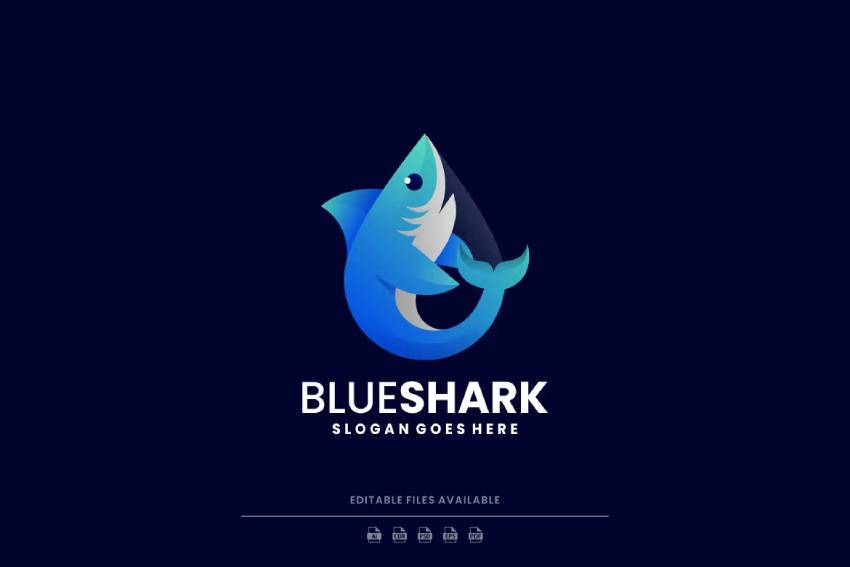
Here's another one of our premium shark logos on Envato Elements. It can be used for a number of industries, like tech, entertainment, and creative agencies. You can edit this cool shark logo design in Photoshop or Illustrator.
5. Shark Media Logo (AI, EPS)



The cool thing about this shark logo design is that it's minimal while also sticking to the drawing principles we've talked about. Choose it if you like simple designs that are highly versatile.
That's All!
That's it for today. If you want to learn more about animal anatomy, make sure to check my profile for more goodies!
If you enjoyed learning how to make drawings of sharks, then you'll love these drawing tutorials from our Envato Tuts+ instructors!

 How to Draw a Sheep


 How to Draw Animals: Dogs and Wolves, and Their Anatomy


 How to Draw Animals: Cats and Their Anatomy

 How to Draw Anime Hair
 How to Draw Anime Characters

 How to Draw Animal Eyes

 How to Draw Disney Animals

 New Course: How to Draw Animals in Perspective

 How to Draw a Fairy Step by Step

 How to Draw Whales
 By
By



